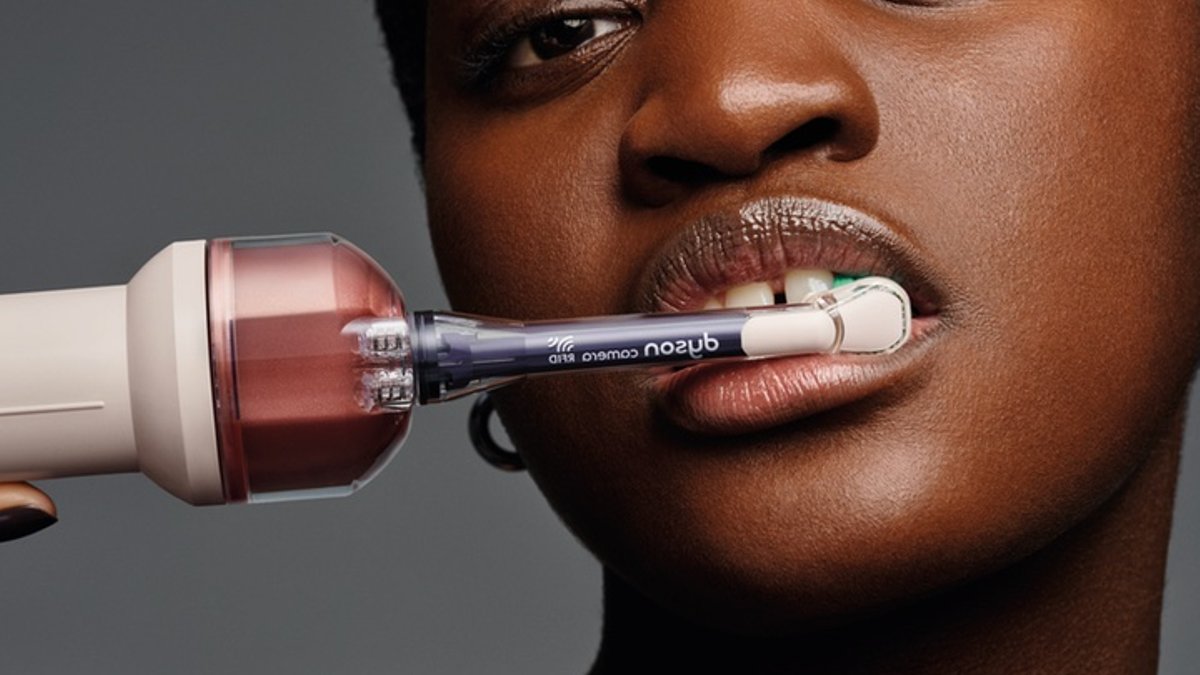
Dyson is entering the oral care market with a £419.99 toothbrush that uses artificial intelligence and precision fluid trends to floss gaps between teeth while brushing. The vacuum technology business’ six-years-in-the-making CameraJet dual-bristle toothbrush features a jet to target plaque in-between teeth, while a camera with AI-powered Gap Optical Targeting technology acts as a high-quality endoscope to identify gaps that need to be precision-flossed. The system is designed to address the friction of traditional flossing by integrating the process into the main brushing routine, though the high price point sets it apart from standard electric toothbrushes.
How the CameraJet works
Inside the toothbrush’s camera is a 100k-pixel macro lens powered by machine learning which detects, tracks and predicts gaps between teeth in real time, triggering a precision jet burst of mouthrinse exactly where it is needed. This AI technology scans 29 live images per second to detect, track and predict gaps between teeth that need flossing in real time, allowing users to see what their dentist sees via the live viewing feature in the company’s MyDyson app. The camera is only active during live viewing or auto-jetting, with no images recorded or stored on the product or in the cloud.
Related: Ulta’s Q2 Sales Lifted by K-Beauty
The CameraJet runs on 16 million lines of code, and a machine learning system trained on 470,000 dental images collected during development. This massive dataset allows the device to recognise patterns in dental anatomy that a human eye might miss. By processing visual data so quickly, the tool can adjust the water jet’s position and force dynamically. It targets the plaque that accumulates in the interdental spaces where standard bristles often fail to reach. The system essentially creates a feedback loop where the brush sees a gap, decides where to spray, and executes the movement without user input.
Engineers spent years optimising the profile of the jet to remove plaque more effectively, and even developed their own proxy plaque through a five-year collaboration with the National University of Singapore’s Faculty of Dentistry. This proxy plaque allowed for rapid iteration during the design phase, removing the need for repeated clinical trials. The Conical Jet claims to jet sweep away plaque with wider coverage, but at a lower pressure to be gentler on gums and enamel. The toothbrush also features a compact, anti-gravity 12.5ml mouthrinse tank that dispenses the optimal amount of product for one session, integrating rinsing into a user’s brushing routine without flooding the mouth.
Related: Diamonds with a Conscience: Why Birmingham Couples Are Saying Yes to Lab-Grown Gems
The full system and pricing
The device comprises a diaphragm pump and pressure chamber that adapts during use to deliver controlled, uninterrupted jets in any orientation. The dual-bristle head also comprises Dyson’s Variable Sonic Oscillation technology, which varies the angle of oscillation while brushing to keep bristles in constant motion and to prevent stalling. The CameraJet toothbrush comes with a docking station that refills the toothbrush with mouthwash at the touch of a button in just three seconds, while also charging the device in between cleans.
Dyson has also launched its own-brand dental system alongside the toothbrush, which includes a mouthwash and proprietary non-foaming toothpaste, formulated without common foaming agent SLS. The brand claims this helps keep foam out of the way so the toothbrush’s camera can see clearly to support its Gap Optical Targeting technology. The toothpaste and mouthrinse both contain sodium fluoride to help fortify enamel and strengthen teeth, alongside phosphates and xylitol to target the bacterial source of plaque and tartar. They are available in two flavours: Ginger Mint and Spearmint.


